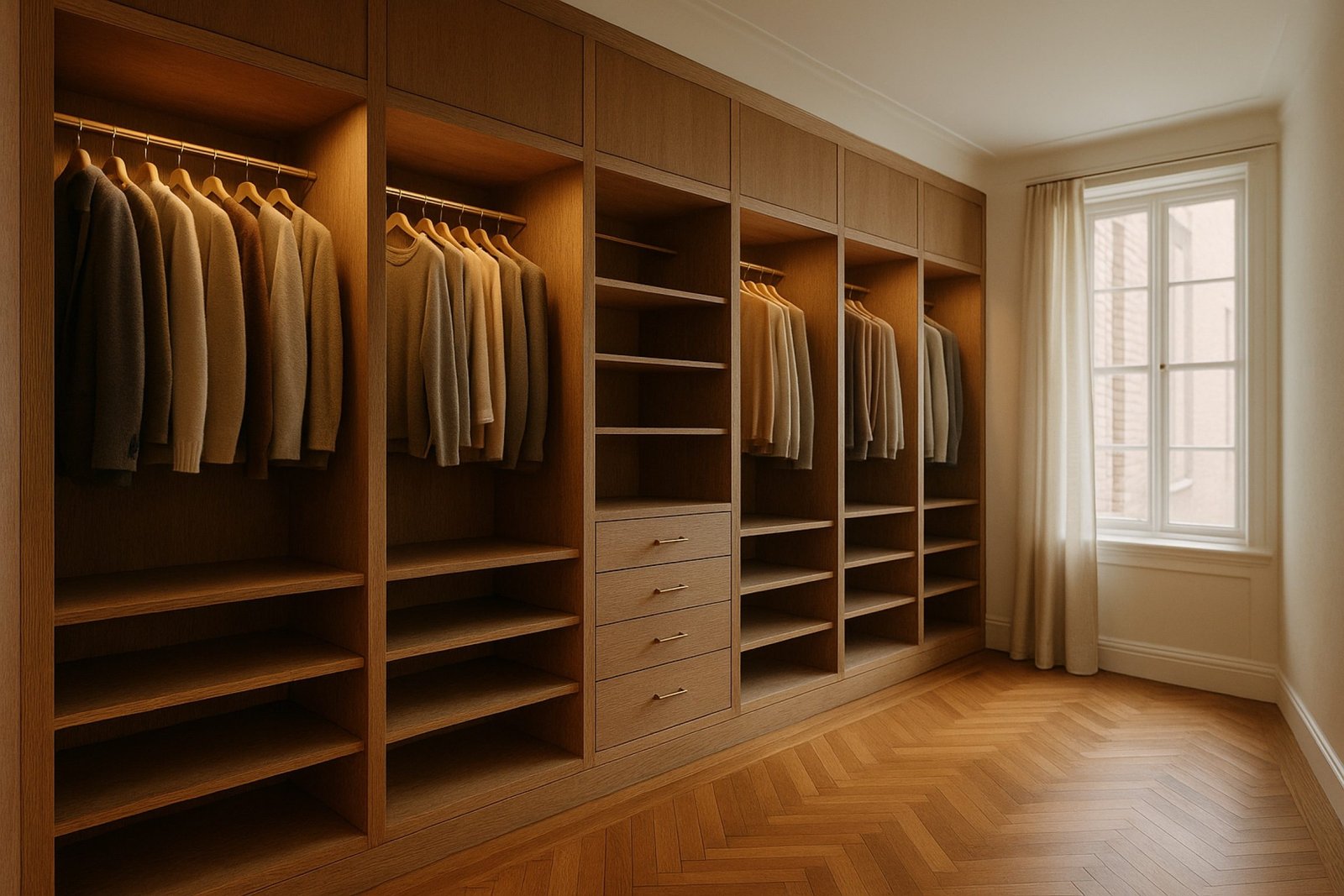
A finish sample is only useful if everyone agrees on what it stands for. The millwork finish sample approval process exists to turn a client's words, such as "warm oak, not orange" or "a white that isn't cold", into one physical piece the workshop can match and the client has already seen in their own room. The loop is short to describe and easy to rush: brief, sample, view, narrow, sign, keep.
The short answer: ask for a sample box chosen to the project, with sample costs and delivery confirmed before anything is ordered. View the samples in the room where the millwork will live, in its own daylight and under its own lamps. Then narrow to one color at one sheen on the real species, and sign a single labelled reference that the workshop keeps as the standard for the run. Natural variation in timber, and the way sheen changes a color, are part of that approval. They are not footnotes to it.
The millwork finish sample approval process, step by step.
- Brief the finish. Give the species and cut (plain-sawn, rift or quartered), or the substrate if the piece is painted. Add the color direction, the sheen you have in mind, and what the millwork has to sit beside: the floor, the stone, the upholstery, the hardware. A photograph of a finish you admire is a starting point, but it can't be the target, because screens and prints shift color.
- Choose the sample box to the project. A full catalog invites indecision. A box built from the brief does better: a few candidates either side of the target, on the right species. Sample costs and delivery are confirmed before anything is ordered.
- View the samples in the room. Look at them standing up, where the cabinetry will stand, across a full day and under the lamps the room will actually have. More on this below.
- Narrow, then re-sample. The second round is the chosen direction on stock intended for the job, at the specified sheen, at a size large enough to read. A panel of around 12 by 12 inches is a typical minimum. Where the profile matters, add a door or drawer-front sample with an edge.
- Sign one reference. Designer and client initial the same physical piece. Its label records what was approved, and from then on it is the standard.
- Keep it, and match to it. The workshop holds the signed reference and the designer keeps a twin from the same batch. Production is checked against the reference before finishing goes ahead, and again before the pieces leave the shop.
What a finish sample can and cannot show.
Each kind of sample settles a different question. Most disappointments come from asking one kind to answer a question that belongs to another.
| Sample | What it settles | What it cannot promise |
|---|---|---|
| Color card or chip | The direction of a color | Sheen on the real substrate; how the color reads across a full wall |
| Finished panel on the project species | Color, sheen and grain character under this finish | That every board or leaf in the run will look identical |
| Door or drawer-front sample | The edge, the profile, the finish over a detail, the hardware against it | How a full elevation of matched doors reads together |
| Veneer leaves from a flitch | Figure, and the match on a feature panel | The final color after finishing, or after years in the light |
A 3D design sets the composition: where the oak runs, where the painted faces stop, how the lit bays sit against the doors. The sample settles the material. We treat the render as direction and the signed sample as the decision. On screen, a finish is a picture of a finish.
See samples in the room's own light.
A sample approved at a showroom table is approved for the showroom. The same oak can read honey-warm in a south-facing room and grey-green in a north-facing one. A New York apartment that looks onto a shaded courtyard or a brick lightwell has a cooler, flatter light than its owners tend to remember. Lamps matter as much as windows. A warm 2700K lamp and a neutral 3500K or 4000K lamp will pull the same white in different directions. Inside a closet, integrated lighting is often the main light the finish will ever see, so put the sample under a similar strip or puck before you sign.
How you hold it matters too. Hold the sample vertically, at the height of the cabinetry, beside the flooring and any stone or fabric it has to live with. Look at it in the morning, in the afternoon and after dark, and leave it in the room for a few days rather than judging it for a minute at the window. If two candidates are close, tape them side by side. Judged alone, either looks fine. Side by side, the right one is usually obvious.
Natural variation in veneer and solid timber.
Timber is not a printed surface. Within one species, boards differ in color between heartwood and sapwood, and in figure depending on how the log was sawn. Plain-sawn oak shows the arched cathedral grain. Rift-sawn oak is straight and calm. Quartered oak carries the ray fleck some clients love and others read as a flaw. Veneer narrows the range, because consecutive leaves from one flitch are close relatives, but leaves from different logs can differ as much as boards do. The match matters as well: book-matched and slip-matched panels from the same leaves look different on the wall.
Species also respond to finish differently. Open-grained oak takes stain readily. Maple and cherry can blotch unless the finish is built to prevent it. Cherry darkens noticeably with exposure to light, while walnut tends to lighten and warm. So the honest wording of an approval is not "it will look exactly like this piece". It is "this color, this sheen and this character, within the natural range of the species." When the range matters, ask to see a lighter and a darker board from the same stock alongside the reference. Our note on solid wood, veneer and painted MDF explains where each substrate earns its place, and painted MDF is the right answer when a client wants no variation at all.
Why does a change of sheen change the color?
Sheen is how much light a surface reflects back toward the eye. Lower sheens scatter light, so the same paint usually reads lighter, softer and slightly chalkier at a matte finish. At satin and above, darker colors look deeper and whites begin to pick up reflections from the room, including the floor, the window and the color of the walls. Higher sheens also show the substrate more plainly, so a surface that is not perfectly flat looks less flat. On clear-finished wood, sheen changes how much the grain glows and how much the pores read.
The practical consequence is simple. Color and sheen are one decision. A paint-store card at one sheen is not the approved finish if the cabinetry will be sprayed at another. Approve both together, on the real substrate, with the finish system the workshop will actually use. We cover color choice more fully in our essay on paint and color for millwork.
The signed reference, and what to write on it.
A reference no one can identify six months later is no reference. The label should carry:
- Project, room and the elevations it applies to
- Species and cut, or the substrate for painted work
- Color name or formula, and the sheen
- The finish system, as the workshop writes it
- Whether interiors, edges and exposed ends match the faces
- The date, and the initials of designer and client
- The line "within the natural range of the species", where timber is involved
Where approvals usually go wrong.
The usual failures are quiet ones. A finish gets approved from a PDF. The color gets approved while the sheen is left as "standard". A single small chip of one board stands in for a forty-foot run. Nobody decides whether the cabinet interiors match the faces. Then there is the change of mind after signing. That is allowed, but the new choice should be sampled and signed in the same way, it should supersede the old reference in writing, and everyone should see what it does to the schedule.
The later phase is the subtle case. Wood and finishes change with light. A reference kept in a drawer ages differently from cabinetry in a sunny dressing room. When a second room is added years on, match to the installed work, not to the stored sample, and say so on the new label.
How samples work on a Kloset Worx trade project.
Under our trade program, a project starts with a free consultation and a personalized 3D design, either on site or at the workshop in the Bronx. We assemble a finish sample box for the project from our materials and finishes, and we confirm sample costs before anything is ordered. The approved finish goes into the written scope and quote, so the reference and the paperwork say the same thing. A named project contact carries the sample loop from the first box to the signed piece. When you write in, we reply within two working days. CAD and Revit resources are available on request, and our notes on how we work with interior designers cover the rest of the relationship.
The work is milled and finished in our own workshop and installed by the same crew, never subcontracted. That makes it easier for a signed sample to mean what it says.
On finish samples and approvals · Published Fall MMXXVI