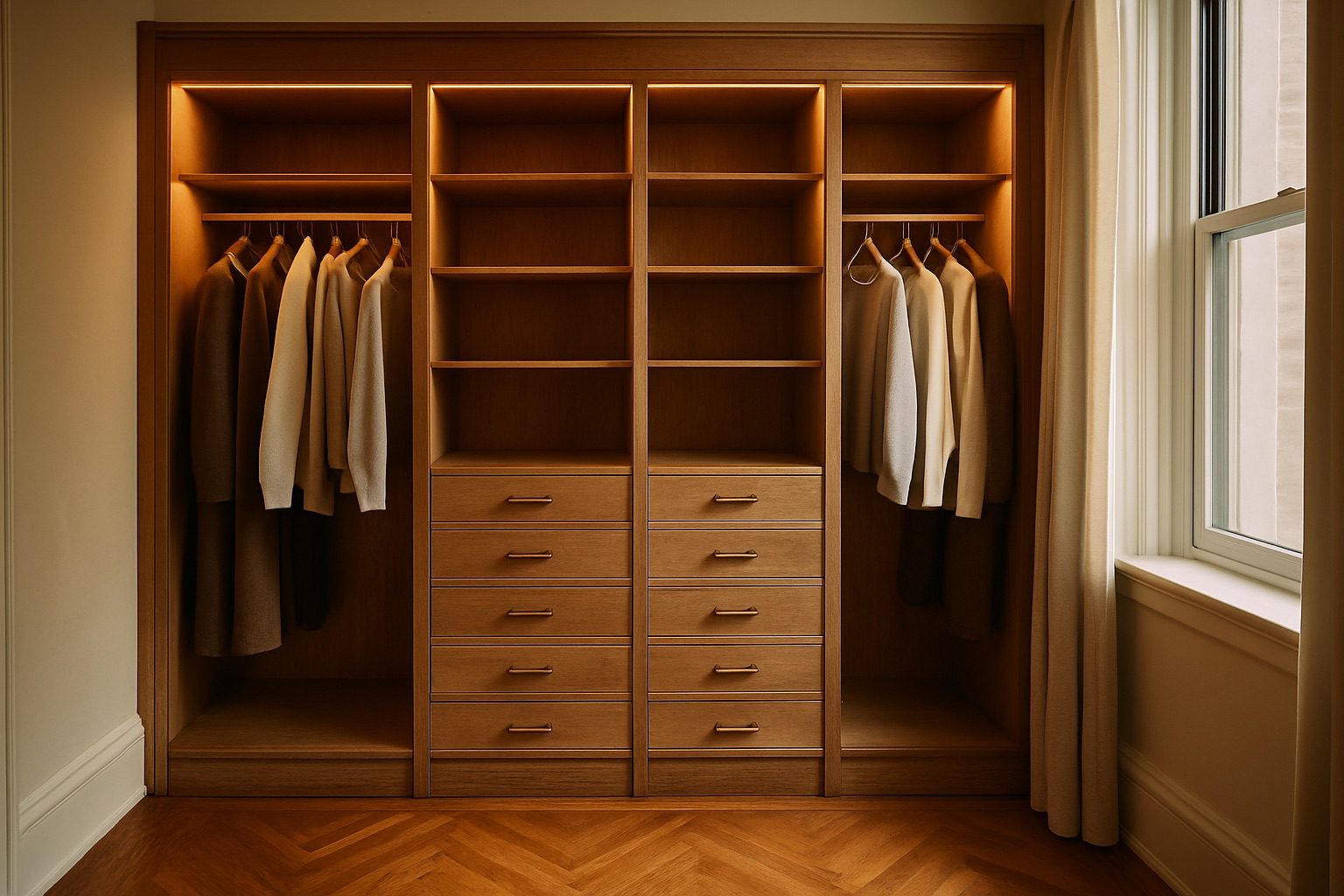
Every L-shaped closet has the same quiet flaw. Hanging storage wants about 24 inches of depth, and where two runs of it meet at an inside corner, those two depths overlap in a square roughly two feet by two feet. Hangers on one wall collide with hangers on the other. Nothing in that square can be reached from the front, so it fills with whatever fell there last. In a small New York apartment, that is four square feet of plan, floor to ceiling, doing no work.
Why modules leave the corner empty.
Configured systems are built from boxes of fixed width, and boxes only meet cleanly on a straight wall. At the corner, one run butts into the side of the other, and the square behind it becomes blind. The usual answer is a filler panel or an open gap, which is honest about the geometry but gives up the space entirely. On a single hanging level that costs about 24 inches of rail on one wall; in a double-hang closet it costs twice that, which in shirts on slim hangers is several dozen garments with nowhere to go. It is one of the clearest places where made-to-measure work differs from a catalog, a distinction we draw more fully in our custom-versus-configured guide.
Three ways to turn it.
The L-return rod carries hanging continuously around the corner on a single bent or bracketed rail, so garments fan through the turn instead of stopping short of it. The innermost few inches are slower to reach, which makes the return ideal for off-season coats or the long tail of a shirt collection. Carousel and quarter-round shelves suit shoes, bags and folded knitwear: a rotating shelf sized to the corner brings the back of the square to the front with a turn of the hand, while fixed quarter-rounds are simpler and never need service. An angled rod, set across the corner and pulled back far enough that shoulders clear both walls, trades some rail for easy reach, and suits a corner you pass every morning. In a dressing room with depth to spare, a corner can also take a full-height mirror or a tall cabinet for luggage, which is sometimes the calmer choice.
The corner in a New York room.
Real corners are rarely the neat right angle a drawing assumes. In prewar plaster, two walls can meet a degree or two out of square and bow along their length, so a return has to be scribed to the wall rather than pushed into it. Tenement layouts often put a chimney breast, a riser or a radiator right where the L wants to turn, and the corner then becomes a matter of working around a fixed obstruction that the super still needs to reach. Drawers and doors need their own allowance too: where two drawer banks meet, a filler of two to three inches keeps handles from colliding and lets both open fully. None of this is visible on a floor plan, which is why we measure the actual angle and the actual obstructions on site, then draw the return in 3D before anything is milled. The same logic runs through wider reach-ins that wrap onto a side wall.
When the corner is worth the millwork.
A turned corner adds cost: bent rails, rotating hardware and scribed returns take longer to make and install than straight runs. It earns its place when the closet is small enough that two feet of rail matters, or when the corner sits at the heart of a walk-in you use every day. If the L is generous and the wardrobe fits comfortably on the straight walls, closing the corner with a clean panel can be the right call. Reach-ins start at about $3,500 and dressing rooms at about $18,000; how the corner changes that is set out in our NYC closet cost guide. The wider principle — that the leftover square foot is where a small apartment gains or loses its storage — is the subject of our space optimization guide.
The practical facts, briefly: every Kloset Worx corner is designed in 3D, milled in our own workshop at 382 Canal Place in Mott Haven, and installed by the same crew that built it — never subcontracted. We have worked this way since 2008, and the cabinetry carries a 25-year guarantee. The design visit and the personalized 3D design are free, with no payment and no obligation to purchase; the design is yours to keep, and fabrication and installation are quoted separately. Bring the two wall lengths, the ceiling height and a sense of what the corner should hold.
Drawn from the survey book, city apartments · Published Fall MMXXVI