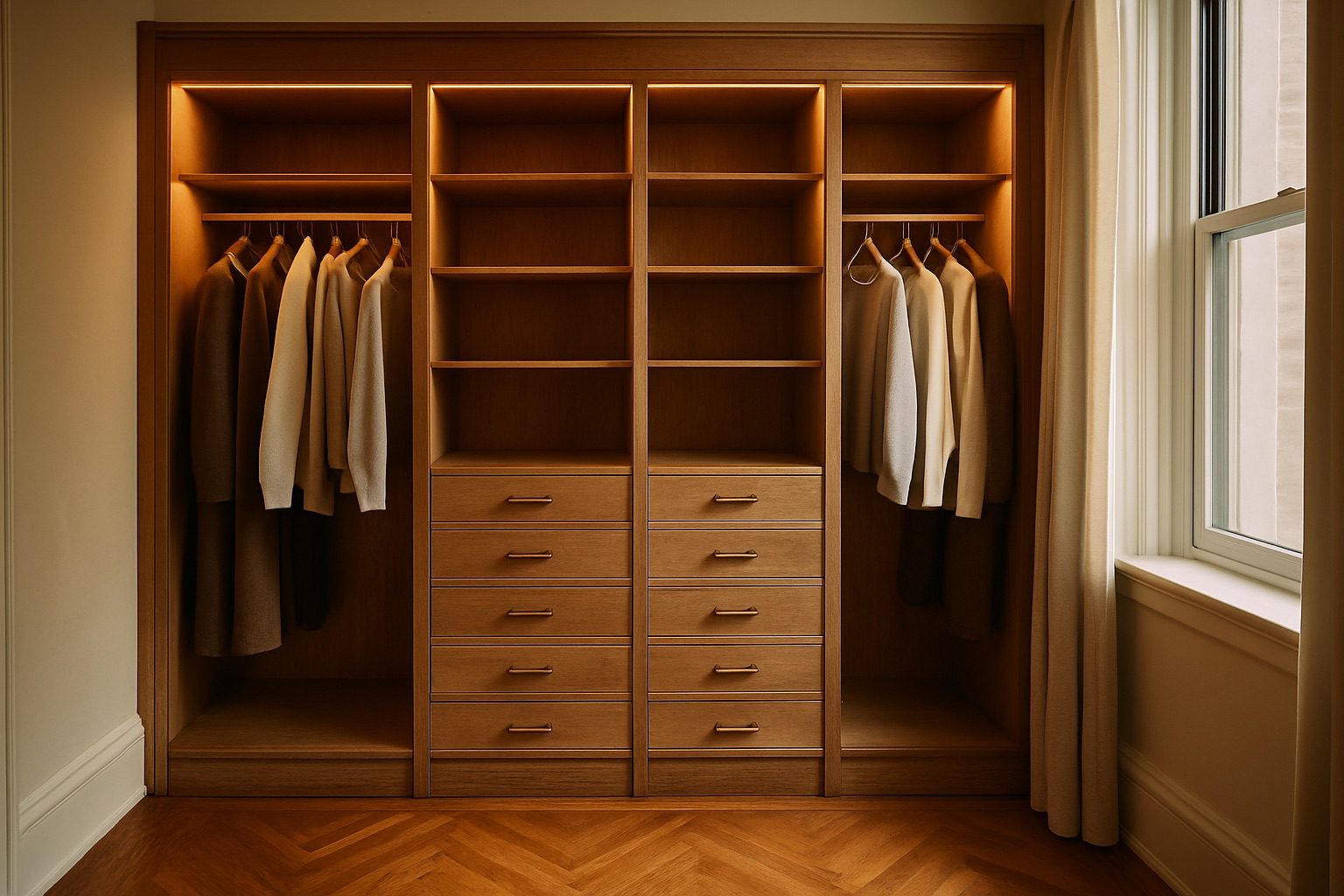
Are custom closets worth it? Most of what you will read on the question is written to sell you one, and most of it answers by listing benefits. A more useful answer starts with your situation rather than with a vendor: how long you will use the room, how far it departs from standard sizes, how much has to live in it, and what the building allows.
The short answer: a custom closet is usually worth it when you own the home, expect to use the room for many years, and the space or the wardrobe does not suit standard modules. It is usually not worth it on a short lease, ahead of a quick sale, or in a plain opening a well-chosen modular system already fits. Resale is a modest bonus, not the reason to buy.
We make closets for a living, so read what follows with that in mind. We have tried to write it the way we talk at a first visit, including the part where we suggest a cheaper route.
What you are actually paying for.
“Custom” is used loosely, so it helps to say what the premium buys. There are four things. The first is fit: cabinetry scribed to walls that are out of plumb and floors that are out of level, so there are no filler gaps or wobbling end panels. The second is height: casework taken to the ceiling, which in many homes is where most of the unused volume sits. The third is a layout drawn around your wardrobe — the actual split between short hanging, long hanging, folded clothes, shoes and off-season storage — instead of a standard elevation. The fourth is construction and finish: solid drawer boxes, quality runners, panels that match the joinery or paint elsewhere in the home, and a guarantee measured in decades.
What the premium does not buy is equally important. A custom closet does not create floor area, it does not fix a wardrobe that is simply too large for the room, and it does not pay itself back on sale. If the honest problem is too many clothes, an afternoon of editing is the cheapest closet upgrade there is.
Are custom closets worth it? Four questions decide it
How long will you use the room?
This is the largest single factor. Fitted cabinetry stays with the home, so its value to you is the number of years you open those doors. As a rough rule, if you expect to stay five years or more, the cost spreads thin enough that daily convenience starts to justify it. Under two years, it rarely does.
How far does the room depart from standard?
Modular systems are built in fixed widths and depths. A straight opening with square walls and an ordinary ceiling height suits them well. A sloped ceiling, a chimney breast, a deep closet with a narrow door, a corner return, or plaster that wanders by half an inch over the height of a wall does not. In a prewar apartment with out-of-square walls, the gaps a catalog system leaves behind are exactly where custom work earns its cost.
How much has to live there?
A modest wardrobe in a reasonable closet seldom needs bespoke work. A large one, or a wardrobe with a specific shape — many long garments, a lot of shoes, tailoring that needs depth — benefits from a layout drawn around it. So does a closet shared by two people with different habits.
What does the building allow?
Apartment buildings add their own conditions: elevator bookings, insurance certificates, work hours and sometimes board approval. Those do not make custom work less worthwhile, but they do favor a maker who measures precisely and installs in a planned visit. Our guide to co-op and condo closet installation covers the questions worth settling first. Renters face a different limit: fitted work may need the landlord's consent and stays behind when you leave.
The decision, situation by situation.
The table is a summary of how we would usually advise, not a rule. Your room may sit between two rows.
| Your situation | Custom usually worth it? | Why |
|---|---|---|
| Renting, moving within two years | Rarely | The work stays behind; freestanding pieces move with you |
| Selling within a year | Rarely | A tidy, simply fitted closet shows nearly as well |
| Owner, standard opening, straight walls, modest wardrobe | Optional | A good modular system may do most of the job |
| Owner, staying five years or more, irregular room | Usually | Fit and full height recover space standard sizes cannot |
| Large wardrobe, or a room doing several jobs | Usually | The layout follows what you own, not a catalog elevation |
| Finish must match existing millwork | Usually | Matching species, profile and paint is hard to do off the shelf |
When a custom closet is not worth it.
We would rather say this plainly than lose your trust later. Custom work is the wrong purchase if you are leaving soon, if the opening is ordinary and a modular system genuinely fits, if the budget would be strained for something a rod, a shelf and a few rigid boxes could solve, or if you are hoping the cabinetry will return its cost at sale. It is also the wrong purchase when the decision is really about appearance alone in a closet behind a door nobody else opens; a lower-cost route can look perfectly good. We set out the four ways to get a closet — flat-pack, national franchise, local firm and a maker like us — in our comparison of custom, franchise and flat-pack closets, including the rooms each one suits.
Do custom closets add resale value?
They help, but not in the way the sales pitch suggests. Buyers notice storage, and fitted closets read as part of the architecture, which makes a bedroom easier to imagine living in. That can help a home show and sell. What we would not tell you is that closet work comes back dollar for dollar. Taste is personal, a very specific layout may not suit the next owner, and a lavish finish is a pleasure for you rather than an asset for an appraiser. The sound way to think about it: buy custom for the years you will use it, and count resale as a small bonus. If you are selling soon, a simple, neutral fit-out is the better spend.
The arithmetic of years.
Our published starting points are about $3,500 for a custom reach-in closet and about $18,000 for a walk-in dressing room; the price rises with size, drawers, doors, finish and lighting. The useful way to weigh that is per year of use. Spread over a decade or more, a well-made reach-in costs a few hundred dollars a year — less if it lasts longer, which good cabinetry should. A modular system costs less at the start, but if it sags, is replaced at the next move, or leaves a third of the wall unused, the yearly figure narrows. The full breakdown of what moves the price is in our guide to what a custom closet costs in New York, and the closet cost estimator gives a rough band for your own room.
Longevity is the other half of the sum. Our cabinetry carries a 25-year guarantee, and we have been building since 2008; the care and guarantee page sets out what is covered and how to look after the finish so the years actually accrue.
How to decide in an afternoon.
- Edit first. Remove what you no longer wear, so you size the closet for the wardrobe you keep.
- Count by category. Rough tallies of short hanging, long hanging, folded, shoes and bags tell you more than any brochure.
- Measure the opening and the ceiling. Width, depth, height, and anything in the way: outlets, radiators, sprinkler heads, trim.
- Be honest about time. Write down how many years you expect to use the room.
- Price both routes. Get a modular layout and a custom design for the same room, then compare per year of use, not just the total.
If the room is standard and the horizon short, the modular route will usually win, and that is a fine outcome. If the room is awkward, the wardrobe large and the horizon long, custom tends to pull ahead. Our design visit and personalized 3D design are free, with no payment or obligation; fabrication and installation are quoted separately, in writing, so you can make the comparison with real drawings in hand.
On cost and judgment · Published Fall MMXXVI