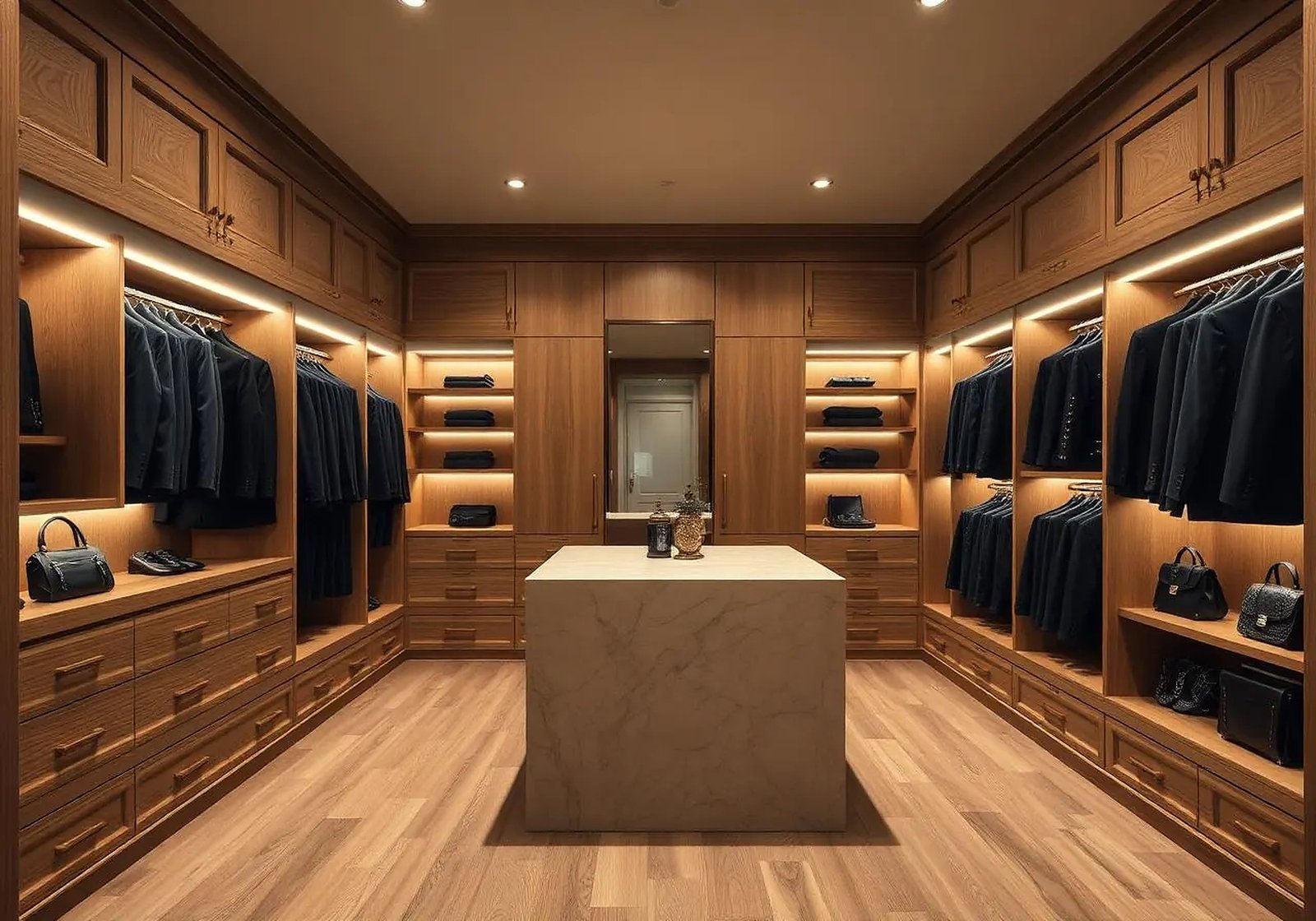
A closet is a room where you choose colours, and most closets are lit worse than any other room in the home. Good closet lighting is built into the cabinetry, comes on by itself, and shows clothes in their true colour.
Key numbers
Where the light goes.
- Over hanging — an LED rod, or a strip on the underside of the shelf above, lighting the front of the clothes.
- Under shelves — a strip at the front edge of each shelf, washing the shelf below.
- Vertical — strips in the front edge of panels, lighting the bay from the sides.
- Inside drawers and cabinets — small strips that switch on when opened.
- Overhead — the ceiling light still matters, especially in an island dressing room.
LED strips are set into aluminium profiles with a diffuser: the profile carries heat away so the LEDs last, and the diffuser turns a row of dots into a continuous line. See the closet lighting essay.
Colour temperature and CRI.
Colour temperature (kelvin) describes how warm the light looks. 2700K is warm and residential, 3000K slightly crisper; 4000K and above reads clinical in a home closet. Match the rest of the room.
CRI (colour rendering index) describes how faithfully light shows colours, out of 100. In a closet — where navy has to look different from black — specify 90 or higher. Cheap strips at CRI 80 make clothes look flat and grey.
Drivers and wiring.
LED strips run on low-voltage DC (usually 12V or 24V) supplied by a driver, which converts household current. Size the driver to the total wattage of the strips (watts per foot × length) plus about 20% headroom, and place it where it can be reached for service and can shed heat.
For shelf lighting, the Kloset Worx standard is that each lit shelf gets its own home-run wire back to a distribution block sized to the shelf count, rather than daisy-chaining one shelf to the next. It makes shelves adjustable and faults easy to trace. Line-voltage work (new circuits, junction boxes, the driver's supply) is done by a licensed electrician.
Sensors and switching.
| Control | How it works | Best for |
|---|---|---|
| Door sensor (IR) | Light on when a cabinet door opens | Doored cabinets, reach-ins |
| Motion (PIR) | Light on when someone enters | Open walk-ins, dressing rooms |
| Wall switch / dimmer | Manual, with dimming | Dressing rooms used as rooms |
| Smart control | App, voice, scenes | Whole-home systems |
Add timeouts so lights switch off if a door is left open. Plan outlets too: a charging drawer, a steamer, a lit mirror and a safe may all need power.
Common mistakes.
- 4000K strips that make the closet look like an office
- Bare strips without profiles — visible dots, short life
- An undersized driver hidden where nobody can reach it
- Daisy-chained shelves that can't be moved
Check yourself.
What colour temperature is best for closet lighting?
2700K to 3000K warm white, with a CRI of 90 or higher so colours look true.
Should closet lights use motion or door sensors?
Door sensors suit cabinets and reach-ins with doors; motion sensors suit open walk-ins and dressing rooms.
Do closet LED lights need an electrician?
The low-voltage LED wiring can be done by the cabinetmaker, but any household-voltage work — new circuits, junction boxes, the driver's power supply — should be done by a licensed electrician.
Finished the module? Mark it complete — your progress is saved on this device.