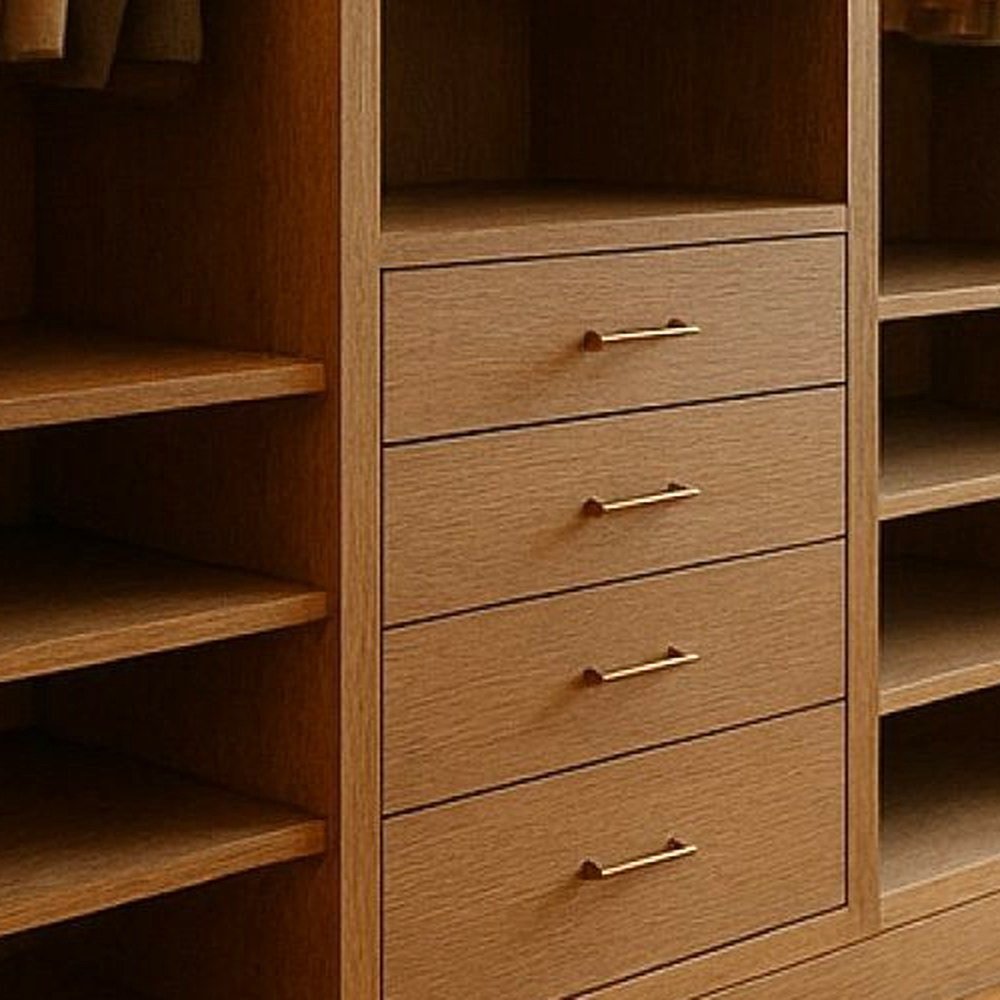
Construction is the part of a closet you never see and always feel: drawers that glide and close themselves, doors that stay aligned, shelves that stay flat. Here is what to ask for and why.
Key numbers
How the boxes are built.
Frameless (European) construction builds each cabinet as a box with the doors covering its front edges. It gives the most interior space and the clean, flush look of contemporary closets. Face-frame construction adds a solid-wood frame to the front of the box; it is the traditional American style and suits inset doors and period rooms.
Most fitted work is drilled on the 32mm system: lines of holes 32mm apart that locate shelf pins, hinges and slides precisely. Panels are joined with dowels, confirmat screws or dados; backs are let into grooves rather than stapled on. Drawer boxes in fine work are solid wood or Baltic birch with dovetail or dowelled corners.
Ask for shop drawings — the detailed plans, elevations and sections that show every panel before fabrication. Read what shop drawings show.
Doors: styles and overlays.
| Overlay | Looks like | Notes |
|---|---|---|
| Full overlay | Doors cover the box; small reveals between | Contemporary, most storage |
| Inset | Doors sit inside the frame, flush | Traditional, precise, more costly |
| Partial overlay | Frame visible around doors | Builder-grade look |
Styles: slab (flat), Shaker (frame and flat panel), raised panel, fluted or reeded, glass (clear, fluted, bronze), mirror, cane or fabric panels. Operation: hinged, sliding (no swing space needed, but only half the closet is open at once), bifold, pocket, and lift-up for high cabinets. See door options for small rooms and custom doors.
Hinges, slides and lifts.
- Concealed hinges — the 35mm cup hinge, adjustable in three directions, with integrated soft-close. Tall doors need three to five hinges.
- Drawer slides — full-extension, undermount and soft-close is the fitted standard: the whole drawer comes out, the slides are hidden, and the drawer closes quietly. Side-mount ball-bearing slides are stronger for very wide or heavy drawers.
- Push-to-open — for handle-less fronts; pairs with matching mechanisms on doors and drawers.
- Lift-ups — gas or spring stays that hold a top door open overhead.
- Rods — oval or round, in metal finishes to match the pulls, often with integrated LED.
Pulls and knobs.
Pulls are where a closet shows its jewellery. Common choices: knobs for doors, bar or edge pulls for drawers, long appliance-style pulls for tall doors, integrated finger grooves or push-to-open for a quiet front. Finishes include polished and satin brass, nickel, chrome, bronze, black and leather-wrapped. Keep one finish family per room and size pulls to the front — roughly a third of a drawer's width reads well.
Common mistakes.
- Hinged doors in an aisle too narrow for them to swing
- Three-quarter-extension slides — the back of the drawer becomes a black hole
- Too few hinges on a tall door
- Pulls in three different finishes
Check yourself.
What is the difference between inset and overlay doors?
Overlay doors sit on the front of the cabinet and cover it; inset doors sit inside the frame, flush with it, for a more traditional and precise look.
What drawer slides are best for a closet?
Full-extension, soft-close undermount slides: the whole drawer comes out, the slides are hidden and the drawer closes quietly.
What is frameless cabinet construction?
A cabinet built as a box with the doors covering its front edges and no face frame — it maximises interior space and gives a clean, flush look.
Finished the module? Mark it complete — your progress is saved on this device.