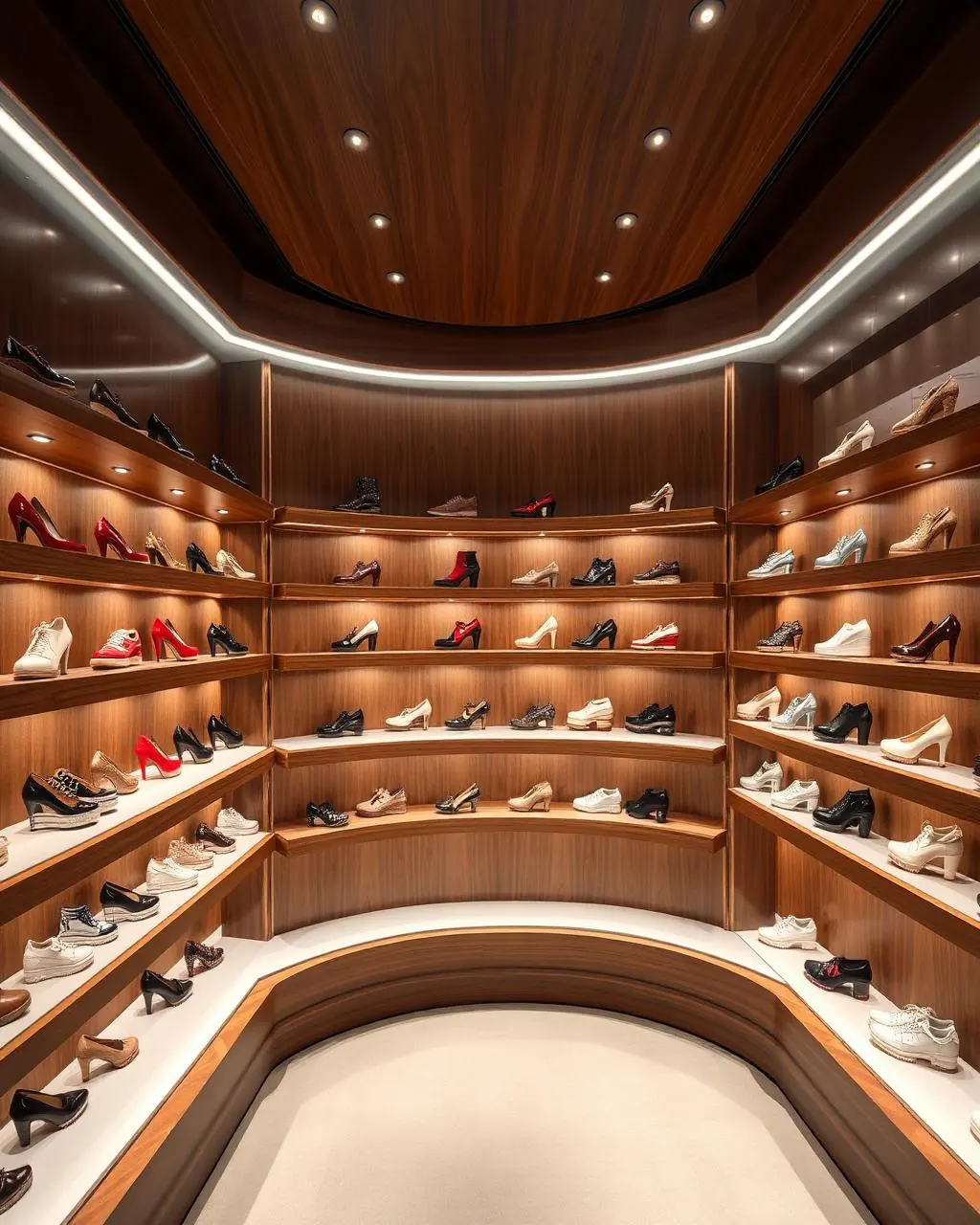
Hanging and folding cover most of a wardrobe; the last part — shoes, bags, jewellery, laundry and the odd things every household owns — is where a closet stops being generic and starts being yours.
Key numbers
Shoes.
Count pairs, then allow 7–9 inches of shelf width per pair (wider for men's shoes and sneakers). Spacing between shelves depends on what sits on them:
| Shoe type | Shelf spacing |
|---|---|
| Flats, sandals, loafers | 5–6" |
| Sneakers, men's shoes | 6–8" |
| Heels | 8–10" |
| Ankle boots | 10–12" |
| Tall boots | 16–20" |
Flat or slanted? Slanted shelves with a lip show more of each shoe but hold fewer pairs; flat adjustable shelves hold more and change with the collection. A shoe wall with 12–14-inch-deep shelves fits most shoes one pair deep; at 24 inches you can store pairs front to back, which works for out-of-season pairs only. Small closets have their own tricks — see shoe storage for small closets.
Jewellery, watches, ties and belts.
Shallow drawers (3–4 inches inside) with velvet or leather-lined dividers keep jewellery visible and untangled. Common inserts: ring rolls, earring grids, necklace bars, watch cushions, glasses trays. A lockable top drawer or an integrated safe (bolted to the structure, with a power line if it is digital) keeps valuables out of sight. Ties and belts go in a pull-out rack or a divided drawer; scarves on a pull-out rod.
Fittings that earn their place.
- Valet rod — a pull-out rod for tomorrow's outfit or dry cleaning.
- Trouser rack — a pull-out rack holding trousers folded over bars; saves a hanging bay.
- Pull-down wardrobe lift — brings a high rod down to reach.
- Tilt-out hamper — a cabinet door that tips out with a removable bag; one or two (lights and darks).
- Ironing board — folding board in a drawer or in a door-mounted cabinet.
- Mirrors — full-length on a cabinet door, on a pull-out, or as a panel on an end wall.
- Bench or island — somewhere to sit and to lay things out; an island top at 36–40 inches.
- Charging drawer — an outlet inside a drawer for phones and watches.
- Luggage — the top bay or the space over a long hang; plan its height to the actual suitcases.
Handbags and hats.
Handbags keep their shape best upright on shelves 14–16 inches deep with dividers every 10–14 inches, or in glass-fronted cabinets that keep dust off. Hats store best in deep drawers or on the top shelf in boxes. Leather needs air: avoid sealing bags in plastic, and keep them out of direct sunlight.
Common mistakes.
- A shoe wall with fixed spacing that won't take boots
- Hampers without ventilation
- A safe that isn't bolted to the structure
- Fittings chosen from a catalogue rather than a habit
Check yourself.
How much space do shoes need in a closet?
About 7–9 inches of shelf width per pair. Space shelves 5–6 inches apart for flats, 8–10 for heels and 16–20 for tall boots.
Are slanted shoe shelves better than flat?
Slanted shelves display shoes better but hold fewer pairs; flat adjustable shelves hold more and adapt as the collection changes.
What is a valet rod?
A small pull-out rod, usually mounted inside a bay, for hanging the next day's outfit or clothes going to the cleaner.
Finished the module? Mark it complete — your progress is saved on this device.